
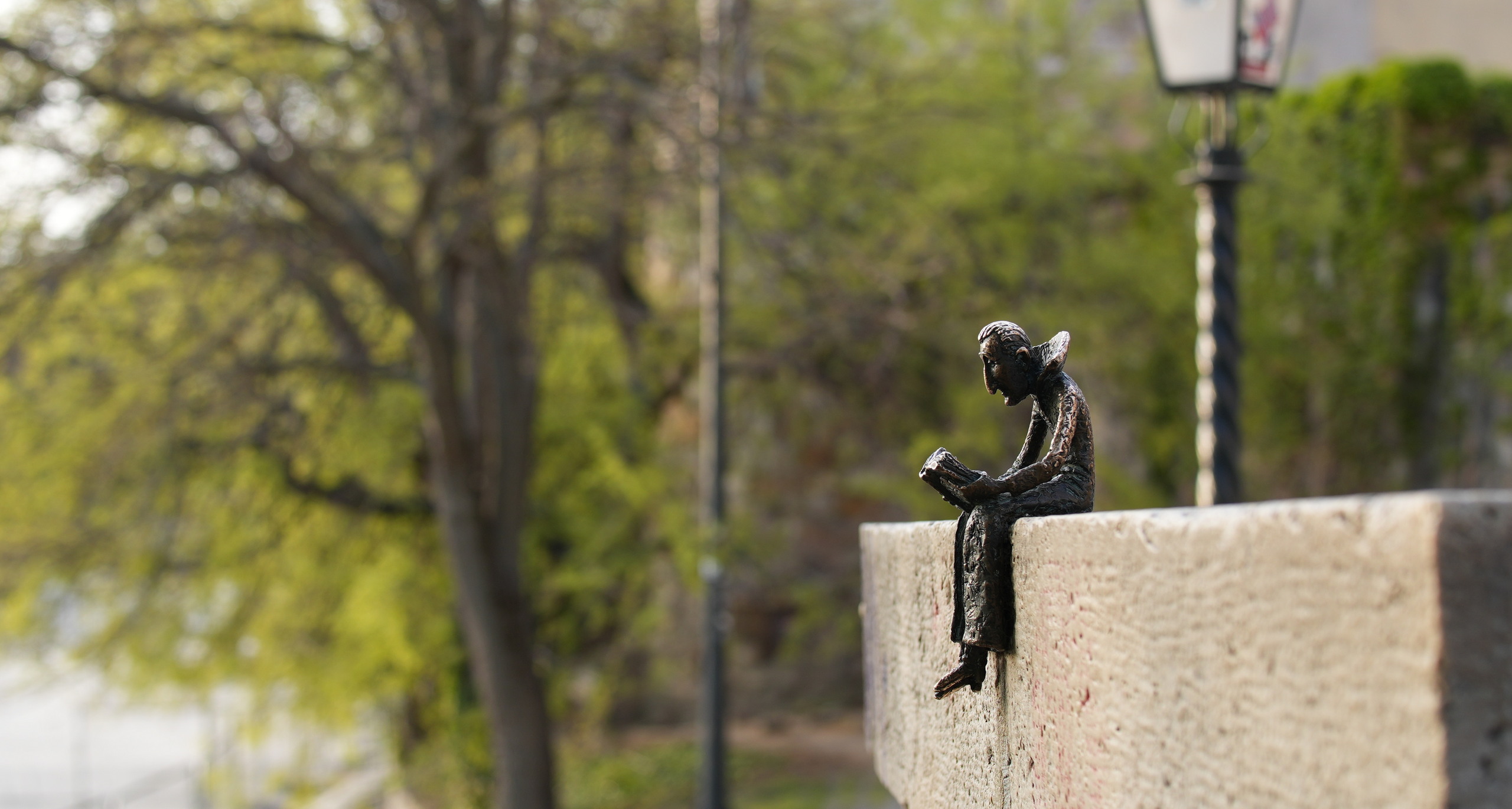

If you spend enough time walking the streets of Budapest, you will eventually notice locals staring intensely at a random stone bollard or crouching by a bridge railing. They aren’t looking at the architecture; they are looking for a Kolodko. Mihály Kolodko, a Ukrainian-Hungarian sculptor, has turned the capital into a massive, open-air scavenger hunt.
Instead of grand, towering monuments, his “guerrilla” bronze miniatures pack deep historical, political, and cultural commentary into pieces no bigger than your hand. They force us to slow down, look closely, and appreciate the layers of our city. Here is the complete list and the stories behind them.
The Man Behind the Bronze: Mihály Kolodko
Mihály Kolodko is a Ukrainian-Hungarian sculptor from Uzhhorod (Ungvár). He started his career with traditional, large-scale monuments, but he eventually found his true calling in “guerrilla” art. By placing these tiny bronze figures in public spaces unannounced, he turned the city into a giant, free scavenger hunt.
What I love most is the “Kolodko Scale.” By making the statues small, he forces us to stop, slow down, and actually look at the details of our surroundings.
The Kolodko Map: Every Statue in Budapest (as of April 2026)
To help you on your treasure hunt, I’ve compiled the most up-to-date list of the miniatures scattered across the capital.
The Pest Side
Micimackó (Winnie the Pooh)
This statue pays homage to the Hungarian translation of A.A. Milne’s classic. The building it sits on was the birthplace of renowned Hungarian writer Frigyes Karinthy. Karinthy’s sister, Emília—who went by the nickname “Mici”—was instrumental in helping him translate the book, so he named the bear “Micimackó” in her honor. The bronze depicts the bear reaching eagerly for a pot of honey.
📍Location: VII. District, Damjanich utca 27 (on the facade of the building).
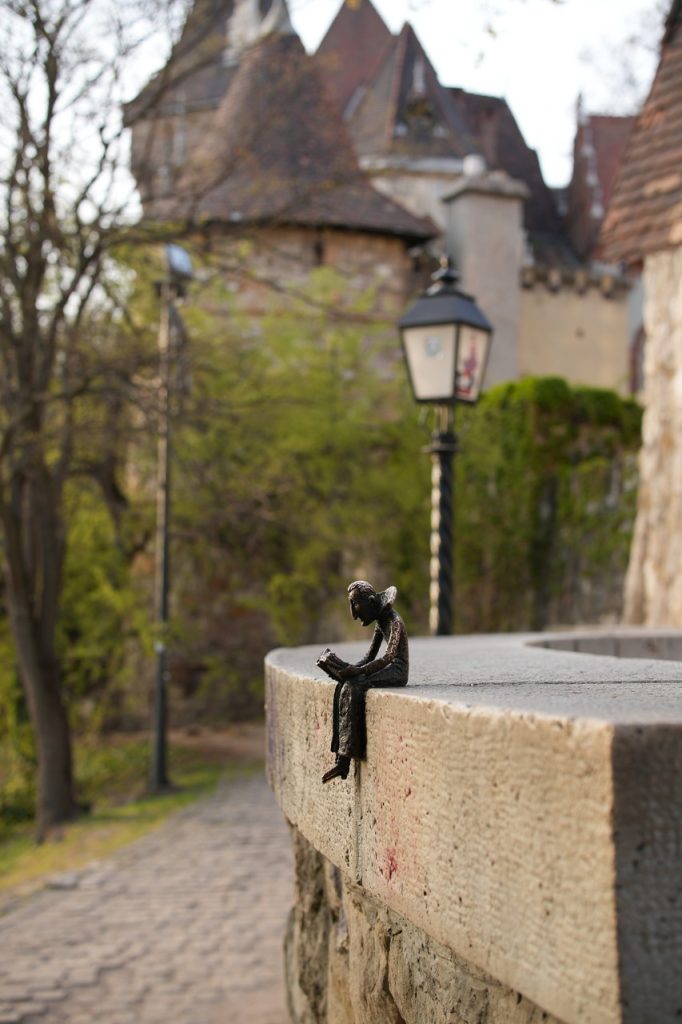
Drakula (Béla Lugosi)
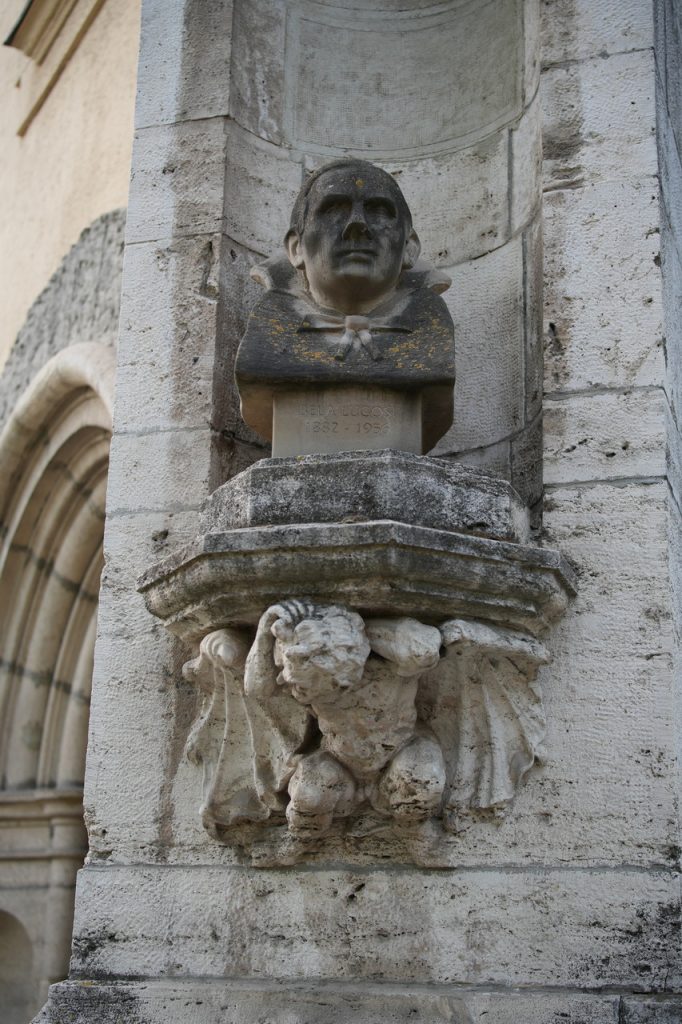
Before he became the iconic face of Hollywood’s Dracula, Béla Lugosi was a respected Hungarian stage actor who fled the country after the 1919 political upheavals. Kolodko’s tribute shows him reading a book, cloaked in his signature cape, hiding in the shadows of the park’s Gothic architecture. It is a subtle nod to how the actor became permanently trapped in the role of the vampire.
📍Location: XIV. District, Városliget, Vajdahunyad Castle (hidden in a rear wall niche).
A Piszoár (The Urinal)
Located a short walk from the Museum of Fine Arts, this is a direct, miniature tribute to Marcel Duchamp’s controversial 1917 Dadaist artwork, “Fountain.” By placing a tiny bronze urinal near the boating lake, Kolodko playfully challenges the boundaries of classic public art and tips his hat to art history’s most famous practical joke.
📍Location: XIV. District, Városliget (on the stone walkway near Vajdahunyad Castle).
Sztálin csizmája / Among Us (Stalin’s Boots)
During the 1956 Revolution, Hungarians famously tore down the massive Stalin monument, leaving only his bronze boots behind. Kolodko recreated these boots and placed a character from the modern video game Among Us next to them. Situated on the skateable roof of the new museum, it bridges dark 20th-century history with modern pop culture, playing on the game’s theme of “imposters” among us.
📍Location: XIV. District, Dózsa György út 35 (Museum of Ethnography promenade).
Garfield
The world’s laziest, lasagna-loving cat is depicted gazing longingly at a brick wall. Because of its location near the University of Veterinary Medicine, locals often interpret it as a humorous take on an indoor cat wanting to escape, or perhaps waiting for his next meal from the nearby veterinary students.
📍Location: VII. District, Dembinszky utca 4 (sitting on the pavement edge).
Miksa Róth
Miksa Róth was Hungary’s most celebrated stained-glass and mosaic artist, whose stunning works decorate the Parliament and the Gresham Palace. This miniature shows the artist at work, carefully holding a delicate pane of glass. It serves as a beautiful, quiet invitation to visit the memorial house hidden just behind the door. Location: VII. District, Nefelejcs utca 26 (inside the reception area of the Miksa Róth Memorial House).
Noah’s Ark
Perched near the veterinary university, this tiny bronze ark is a fitting symbol of animal preservation and care. The true magic of this piece is hidden inside: if you get close enough and peek through the tiny windows of the ark, you will see a small, beautifully painted rainbow symbolizing hope after the flood.
📍Location: VII. District, Bethlen Gábor tér (on a stone pillar near the square).
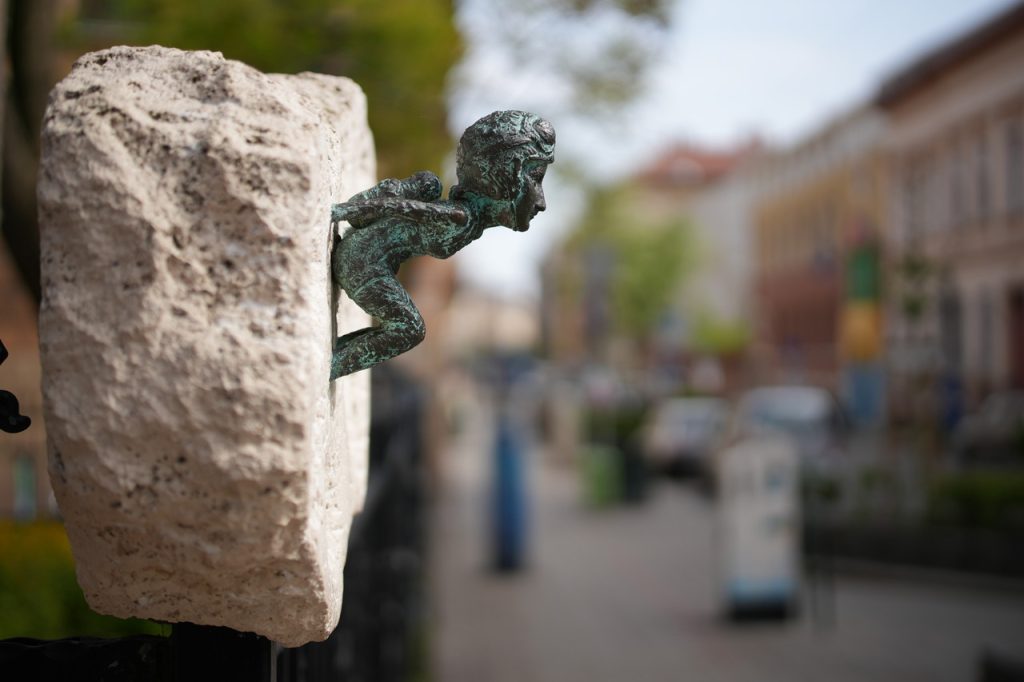
Hanna Szenes
Hanna Szenes was a Hungarian-born Jewish poet who emigrated to Palestine but returned as a British paratrooper to fight the Nazis and save her people. She was captured, tortured, and executed in Budapest at age 23. This powerful memorial shows her in full gear, taking a leap of faith over a limestone map of Hungary, representing the home she died trying to protect.
📍Location: VII. District, Jósika utca & Rózsa utca corner (Hanna Szenes Park, on the stone fence).
The 14-Carat Car
Jenő Rejtő was the undisputed master of Hungarian pulp fiction, known for his hilarious, absurd adventure novels. This beautifully crafted miniature of an Alfa Romeo honors his famous book, The 14-Carat Car. It is parked right at the beginning of the street named after the author, outside a prominent theater.
📍 Location: VII. District, Hevesi Sándor tér 4 (on a stone bollard in front of the Pesti Magyar Színház).
Harry Houdini
Born Erik Weisz in Budapest’s 7th District, Harry Houdini became the world’s most famous illusionist and escape artist. Kolodko honors the local boy who made it big with this indoor statue, depicting the magician wrapped in chains and padlocks, preparing for one of his legendary escapes.
📍Location: VII. District, Király utca 11 (inside the K11 Cultural Center).
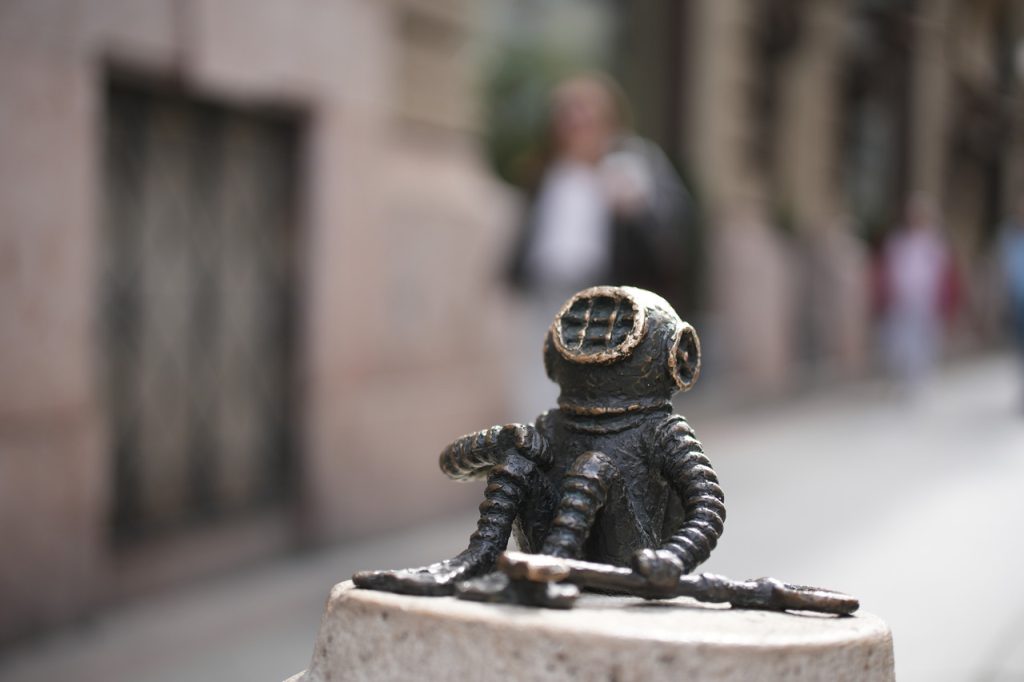
The Diver (A Búvár)
Legend has it that on the opening night of the opulent New York Café, the famed Hungarian writer Ferenc Molnár threw the café’s keys into the Danube so it would never be able to close its doors. Kolodko brought this urban myth to life by sculpting a deep-sea diver holding the legendary key, situated right next to the historic coffee house.
📍Location: VII. District, Dohány utca 53 / Osvát utca corner (on a fire hydrant).
Theodore Herzl
The father of modern Zionism, Theodore Herzl, was born in a house that once stood right next to the Great Synagogue. This miniature shows Herzl standing thoughtfully beside a bicycle, capturing his forward-thinking vision. It’s a poignant historical marker in the heart of the Jewish Quarter.
📍Location: VII. District, Dohány utca 1 (attached to a lamppost near the synagogue).
Rezső Seress
Seress was the composer of “Gloomy Sunday,” a song so profoundly melancholic it was dubbed the “Hungarian Suicide Song” and banned by broadcasters worldwide. Despite his international success, Seress lived a tragic life, surviving the Holocaust but never leaving Budapest, eventually taking his own life. The statue sits outside the restaurant where he played piano for decades.
📍Location: VII. District, Akácfa utca 38 (on the facade of the Kispipa Restaurant).
Szurikáta (Meerkat)
Unlike Kolodko’s deeply historical or political pieces, this one has a purely heartwarming purpose. Installed on the fence of the local Pediatric Clinic, the tiny, inquisitive meerkat is there simply to bring a smile to the faces of sick children and anxious parents arriving at the hospital.
📍Location: VIII. District, Bókay János utca 51 (on the clinic’s brick fence).
Lisa Simpson (Jeanne d’Arc)
Bound to a public transport pole, Lisa Simpson is depicted as Joan of Arc—a direct reference to a classic episode of The Simpsons. Kolodko uses the brilliant, misunderstood middle child as a satirical symbol for the martyrdom of intellect and culture in modern society.
📍Location: IX. District, Fővám tér 13 (tied to a tram stop pole).
Franz Joseph I (Liberty)
Following the Austro-Hungarian Compromise of 1867, the Emperor financed the construction of a beautiful green bridge, which was originally named the Franz Joseph Bridge. Today, it is called Liberty Bridge. Kolodko playfully highlights this irony by placing the former Emperor lounging in a tiny hammock right on the bridge that no longer bears his name.
📍Location: IX. District, Liberty Bridge / Szabadság híd (on the ironwork of the Pest-side pylon).
Füles (Headphones)
Positioned outside the Palace of Arts (MÜPA), this piece goes beyond visual art—it is actually functional. The miniature bronze headphones act as a tiny speaker, quietly playing classical music to those who stop and lean in close. It represents the harmony and acoustics found inside the concert hall behind it.
📍Location: IX. District, Komor Marcell utca 1 (on a stone block outside MÜPA).
Moon Buggy
Many people do not realize that the Lunar Roving Vehicle used during the Apollo missions was engineered by a Hungarian, Ferenc Pavlics. Kolodko immortalized this incredible achievement by placing a tiny bronze replica of the rover on a street perfectly suited for the occasion: Hold utca, which translates to Moon Street. Location: V. District, Hold utca 12 (on a bollard).
Mr. Bean’s Teddy Bear
Nailed to the facade of the former British Embassy building, this is a purely whimsical nod to British pop culture. The knitted texture of Mr. Bean’s beloved companion is flawlessly recreated in solid bronze, adding a touch of absurd humor to the stately, diplomatic architecture of the area.
📍Location: V. District, Harmincad utca 6 (on the building wall).
Kermit the Frog
Sitting casually near the fencing of a local café, Jim Henson’s famous amphibian seems to be taking a coffee break. In the winter, locals frequently knit tiny scarves for him, and occasionally, you might even find a miniature cup placed in his hand. It’s a lighthearted piece in a square heavily dominated by serious political monuments.
📍Location: V. District, Szabadság tér (near the café terrace fencing).
The Axe (A baltás)
This spot originally held a Kolodko sculpture of an “Ushanka” (a Soviet winter hat) resting on a pillow, meant to critique Russian political influence. A right-wing politician took offense and smashed the hat with an axe, throwing it into the Danube. Kolodko’s brilliant response was to replace the hat with a bronze axe on the very same velvet pillow.
📍Location: V. District, Szabadság tér (near the Soviet War Memorial).
Süsü & Gyula Bodrogi
Süsü, the friendly, one-headed dragon, is perhaps the most beloved character in Hungarian television history. This piece honors both the iconic puppet and Gyula Bodrogi, the legendary actor who provided his voice. Fittingly, it is located near the grand building that used to serve as the headquarters for Hungarian Television.
📍Location: V. District, Szabadság tér (near the former MTV headquarters).
Dead Squirrel
Just a few steps behind the famous, life-sized statue of TV detective Inspector Columbo, Kolodko set up a miniature crime scene. A dead squirrel lies on its back, outlined in white chalk and holding a tiny revolver. It’s a brilliant piece of dark humor that invites Columbo to solve one more mystery.
📍Location: V. District, Falk Miksa utca / Szt. István krt. corner (behind the Columbo statue).
Russian Warship
Created in response to the 2022 invasion of Ukraine, this is one of Kolodko’s most overtly political statements. It depicts a tiny Russian warship sinking while resting on top of a stone carved into the shape of a middle finger. Positioned at the edge of the Moscow Promenade, the message to Vladimir Putin is unmistakable.
📍Location: XIII. District, Moszkva sétány (on a stone block by the riverbank).
Balloon Dog
A playful nod to American contemporary artist Jeff Koons, this piece replicates Koons’ famous massive balloon dog sculptures in Kolodko’s signature miniature scale. Resting by the river, it creates a striking contrast between the modern, whimsical pop art and the historic panorama of the Buda Castle across the water.
📍Location: V. District, Belgrád rakpart (on a stone wall near the Chain Bridge).
The Buda Side
Főkukac (The Great Worm)
This was the very first guerrilla sculpture Kolodko placed in Budapest, sparking the city-wide phenomenon. Főkukac is the perpetually optimistic fishing bait from a beloved 1980s Hungarian cartoon. Today, he sits on the riverbank, staring across the Danube at the grand Parliament building, keeping anglers company.
📍Location: I. District, Bem rakpart 15 (on the stone wall facing the river).
Rubik’s Cube
Ernő Rubik’s colorful puzzle took the world by storm in the 1980s and remains Hungary’s most famous modern invention. Kolodko’s bronze tribute to the cube is hidden in a small niche along the stairs leading up from the riverbank. It’s a testament to Hungarian ingenuity, placed just a stone’s throw away from the Great Worm.
📍Location: I. District, Bem rakpart (in a wall niche by the stairs near Batthyány tér).
The Sad Tank
Commemorating the bloody 1956 Hungarian Revolution against Soviet occupation, this miniature T-34 tank features a drooping barrel, symbolizing the tragedy and the ultimate withdrawal of forces. The words “Ruszkik Haza” (Russians Go Home) are faintly etched into its side, making it a powerful, somber historical checkpoint.
📍Location: I. District, Bem rakpart (on the river wall near the Batthyány tér metro).
Drone (Svédcsavar)
One of his more modern commentaries, this piece looks like a sleek surveillance drone or a twisting mechanical bullet resting on the riverbank. It reflects the increasingly mechanized, watched, and remote nature of modern warfare and technology, standing in stark contrast to the historical statues surrounding it.
📍Location: II. District, Bem rakpart (near the Bem tér tram stop).
The Checker-Eared Rabbit (Kockásfülű nyúl)
This resourceful, flying rabbit is a legend of Hungarian animation. True to his character, he is positioned high up on Castle Hill, using his signature telescope to keep a watchful eye over the sprawling Pest side. It is arguably the Kolodko statue with the best panoramic view in the city.
📍Location: I. District, Szent György tér (on the stone wall at the top of the Castle Funicular).
Mekk Elek
Mekk Elek is the bumbling, incompetent goat handyman from a classic 1970s stop-motion TV series. He is famous for constantly messing up his jobs. Kolodko perfectly captured his essence by placing him near a busy bike lane, holding a street sign that he has stubbornly installed pointing in the wrong direction.
📍Location: II. District, Széll Kálmán tér (near the stairs and bike path).
Yoda
Tucked away in the ultra-modern depths of the M4 metro line, the Jedi Master stands vigil by the escalators. With his hand outstretched, he appears to be using the Force to move the commuters up and down the moving stairs. It’s a delightful sci-fi Easter egg for tired travelers.
📍Location: XI. District, Szent Gellért tér (inside the M4 metro station entrance).
Nincs Kompót (No Compote)
This piece is a love letter to the classic Hungarian comedy film The Corporal and the Others (A tizedes meg a többiek). The statue features a tiny, functioning door that, when opened, reveals a terrified Russian soldier hiding among jars of jam. It perfectly captures the film’s chaotic, survivalist humor during WWII.
📍Location: I. District, Ybl Miklós tér (on the Várkert Bazár riverbank wall).
Lecsó (Remy the Rat)
Bridging French and Hungarian cuisine, Remy from Pixar’s Ratatouille is depicted spray-painting the word “Lecsó” onto a wall. Lecsó is the traditional Hungarian pepper-and-tomato stew, heavily resembling the famous French dish. It’s a clever, artistic nod to the universal love of good, rustic cooking.
📍Location: I. District, Döbrentei tér (Erzsébet Bridge Buda bridgehead).
Statler & Waldorf
The two notoriously grumpy old men from The Muppets have found the perfect balcony in Budapest. Overlooking the busy roundabout and the entrance to the Buda Castle Tunnel, they are perfectly positioned to heckle the terrible traffic, passing tourists, and politicians driving up to the Castle District.
📍Location: I. District, Clark Ádám tér (on the railing above the tunnel).
In Vino Veritas
Long before it was Budapest, the area of Óbuda was the Roman city of Aquincum. This miniature Roman legionary, casually kicking back with a jug of wine, honors the ancient roots of the district and the deep, enduring history of Hungarian viticulture. Location: III. District, Szentendrei út (near the Aquincum museum area, on a stone base).
Aranka & Béla
Most of Kolodko’s subjects are famous figures, but Aranka and Béla were simply a real, deeply loved elderly couple who sold flowers at this square for decades. When they passed away, the neighborhood mourned them deeply. Kolodko captured their gentle spirit, ensuring they will always be a part of the square they brightened every day.
📍Location: II. District, Pasaréti tér (near the bus terminal).
Khanty Hunter
One of the newest additions, unveiled in 2026, this piece honors the Finno-Ugric linguistic roots of the Hungarian people. The Khanty hunter, carrying a deer on his shoulders, stands on the edge of the river looking toward the ultra-modern MOL Tower, bridging thousands of years of ancient heritage with the city’s future skyline.
📍Location: XI. District, Rákóczi Bridge (Buda side bridgehead).
The Outskirts & Beyond
Franz Liszt
You don’t even have to be in the city center to start your Kolodko hunt. If you are flying into Budapest, you are greeted by the city’s namesake composer, Franz Liszt. He is depicted sitting patiently on a traveler’s suitcase, welcoming millions of visitors to the capital.
📍Location: XVIII. District, Budapest Airport Terminal 2A (near the entrance).
Chuck Norris
When the Megyeri Bridge was being built, a public online poll was launched to name it. The internet did what the internet does, and “Chuck Norris Bridge” won by a landslide. The government ultimately ignored the poll, but Kolodko didn’t forget. He tied up the action star on the bridge’s pedestrian path in a hilarious act of defiance.
📍Location: IV. District, Megyeri Bridge (attached to the railing on the pedestrian path).
Söröslovak & Antal Dreher
These two separate pieces are located out in the industrial district of Kőbánya, the historic heart of Hungarian brewing. They celebrate Antal Dreher, the “Beer King,” and the sturdy dray horses that once hauled massive barrels of beer across the city, paying respect to the capital’s working-class roots.
📍Location: X. District, Jászberényi út 7-11 (at the Dreher Brewery).
Szent Miklós
Saint Nicholas (the original figure behind Santa Claus) is located in a quiet, residential district. He stands as a peaceful, giving figure holding a book and staff. It is an off-the-beaten-path gem for true Kolodko fans looking to explore the suburbs.
📍Location: XVI. District, Hunyadvár utca 43/c (outside the Corvin Művelődési Ház).
Local Insider Tips for your “Kolodko Tour”
- Look for the “Scarves”: In the winter, locals often knit tiny hats and scarves for the statues. It’s a heartwarming sight and makes them easier to spot!
- The “Hidden” Factor: Some are easier to find than others. The Diver and the Rubik’s Cube are quite obvious, but the Moon Buggy or Franz Joseph on the bridge require a sharp eye.
- Respect the Art: These are made of bronze, but they are fragile in their own way. Please don’t try to pry them off (yes, it has happened).
- Use the Map: If you are a completionist, the Facebook group “Kolodko szobrok kedvelői” is the best place to find the absolute latest “guerilla” drops, as Mihály usually posts a cryptic photo whenever a new one appears.
Finding a Kolodko always feels like a secret handshake with the city. It’s a reminder that even in a place with a history as heavy as Budapest’s, there is always room for a bit of playfulness.
Which one is your favorite? Or did you find a new one I haven’t listed yet? Drop a comment below!

Great article! But you missed the 4 mini dog statues and the coin.
Wow, perfect article!! Thanks a lot for the information!